
Opinion
Abscohmat: A Call For Institutional Accountability And Administrative Reform – By Samuel Okenyi

Abscohmat: A Call For Institutional Accountability And Administrative Reform – By Samuel Okenyi
Concerns Over Leadership, Academic Governance and Administrative Practices at the Abia State College of Health Sciences and Management Technology, Aba
The Abia State College of Health Sciences and Management Technology (ABSCOHMAT), Aba, is an institution of considerable importance to Abia State. Its mandate extends beyond the classroom: it contributes directly to the development of skilled manpower for the state’s healthcare sector.
For an institution with such responsibilities, its leadership and internal administration must be anchored on competence, professionalism, transparency, due process and strict compliance with applicable rules and regulations.
It is therefore necessary to draw attention to a number of concerns and allegations currently being raised regarding the administration and academic management of the College. These matters, while requiring proper verification, are sufficiently serious to warrant the attention of the appropriate authorities.
QUESTIONS CONCERNING ACADEMIC LEADERSHIP
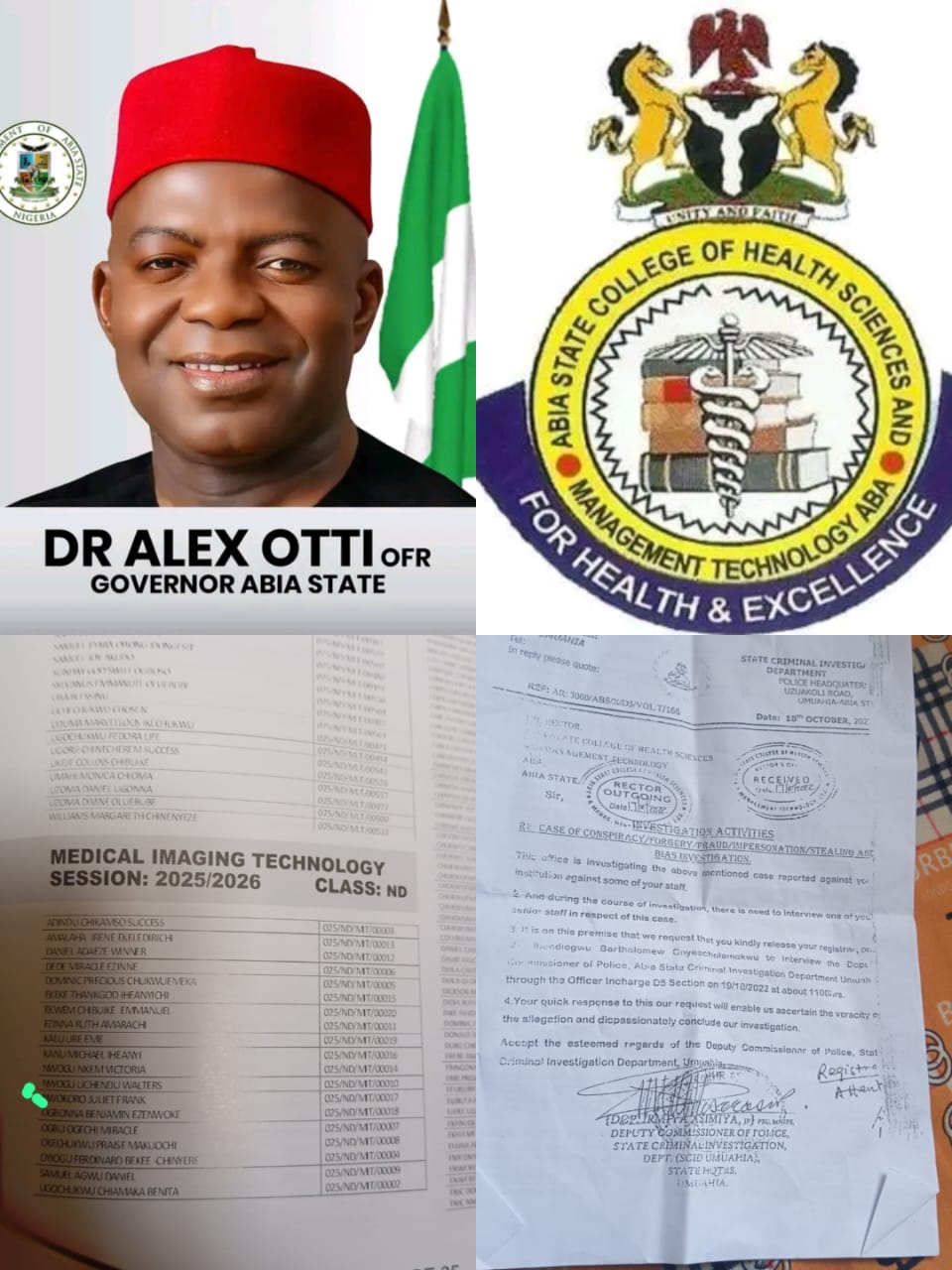
One of the issues that has generated concern is an allegation that the Rector of ABSCOHMAT appointed a student as Head of Department (HOD) of Medical Imaging Technology.
If verified, this would raise legitimate questions regarding the eligibility criteria, qualifications, experience and institutional procedures governing appointments to academic leadership positions.
Academic departments within a health sciences institution require competent leadership capable of supervising teaching, curriculum implementation, examinations, staff coordination and other professional responsibilities.
It is therefore essential that appointments to such positions are based on demonstrable competence and established institutional requirements.
The matter should consequently be subjected to an objective review to establish the facts and determine whether due process was followed.
THE CONTINUED TENURE OF THE REGISTRAR
Another significant concern relates to the continued occupation of the office of the Registrar, whose tenure is alleged to have expired on 7 October 2023.
The issue is fundamentally administrative and should be resolved through documentation.
If an extension or fresh appointment was granted after the alleged expiration date, the relevant instrument should be produced. If no such document exists, the appropriate authorities should determine the implications for the continued exercise of the powers of that office.
Public institutions operate on established rules, and principal offices should be occupied on the basis of clearly defined legal and administrative authority.
THE REPORTED 2022 POLICE INCIDENT
There are also allegations concerning an incident on 19 October 2022, when the Registrar was reportedly invited and detained at a police station in Umuahia in connection with a matter involving a relative of his within the College.
It has further been alleged that the matter subsequently disappeared and that political connections associated with the previous administration may have influenced its outcome.
These claims should not be treated as established facts without evidence. However, because they concern a senior officer of a public institution and an alleged police action, the matter is capable of objective verification.
The relevant police records should establish why the Registrar was invited, the nature of the complaint, whether he was detained, the circumstances surrounding the matter and what ultimately became of the case.
A transparent clarification would help to eliminate speculation and establish an authoritative account of the incident.
ACADEMIC GOVERNANCE AND THE WELLman FLORENCE MATTER
Further concerns have been raised regarding Wellman Florence and her reported academic assignment alongside a relative of the Registrar.
It is alleged that both were assigned to teach Microbiology to Year 1 Public Health students. Subsequently, it is alleged that the Registrar intervened and converted Wellman Florence from a tutorial to non-tutorial staff without her consent, leaving the Registrar’s relative to teach the course alone.
It has also been reported that Wellman Florence possesses higher qualifications and greater experience than the Registrar’s relatives.
If established, these circumstances deserve careful examination, not because academic assignments should be determined by seniority or personal considerations, but because they should be based on objective academic criteria and established institutional procedures.
Of further concern is the allegation that Wellman Florence was warned not to administer examinations to the students she taught during the second semester.
The basis for such a directive should be made clear. Was it consistent with the College’s academic regulations? Who authorised it? Was the same standard applied to other lecturers in comparable circumstances?
These are reasonable institutional questions that deserve documented answers.
THE IMPORTANCE OF STAFF PROTECTION AND DUE PROCESS
There are broader concerns regarding the alleged treatment of staff members who question administrative decisions or raise concerns about the management of the College.
It has been alleged that some staff members have been suspended, victimised or dismissed after questioning decisions they considered inappropriate.
Such allegations, if substantiated, would raise serious concerns about the internal culture of accountability within the institution.
A properly governed public institution must provide mechanisms through which employees can raise legitimate concerns without fear of retaliation. Equally, allegations against employees must be handled fairly, transparently and in accordance with due process.
The objective should be neither to shield management nor to protect employees from legitimate disciplinary processes. The objective should be fairness, evidence and adherence to the rules.
A MATTER FOR INDEPENDENT REVIEW
The issues raised concerning ABSCOHMAT are capable of resolution through a transparent administrative process.
An independent review should examine the relevant appointment records, tenure documents, academic assignments, examination directives, disciplinary records and other documentation necessary to establish the facts.
Such a review would serve the interests of all parties.
If the allegations are unfounded, the exercise would provide an opportunity to clear the names of those affected and restore confidence in the administration of the College. If any of the allegations are substantiated, appropriate corrective measures should be taken in accordance with the law and applicable regulations.
AN APPEAL FOR GOVERNMENTAL ATTENTION
The concerns surrounding ABSCOHMAT deserve the attention of the Abia State Government, particularly given the institution’s importance to the state’s healthcare manpower development.
The Governor, Dr. Alex Chioma Otti, OFR, has an opportunity to ensure that the principles of accountability, merit, transparency and institutional discipline are upheld within the College.
We therefore respectfully appeal to the Governor to direct the relevant authorities to undertake a comprehensive and impartial review of the matters raised, establish the facts and ensure that appropriate action follows from the findings.
We equally appeal for the review of cases involving staff members who may have been unjustly suspended or dismissed. Where it is established that any suspension or dismissal was without sufficient justification or due process, such affected staff should be considered for reinstatement and restoration to their respective offices and places of work.
PROTECTING THE INSTITUTION
The central issue is not about personalities. It is about the future and integrity of an important public institution.
ABSCOHMAT’s students deserve an academic environment in which merit and professional standards are respected. Its lecturers and other employees deserve an environment where legitimate concerns can be raised responsibly and without fear. The government deserves assurance that its institutions are being administered in accordance with the law. And the people of Abia State deserve institutions that command public confidence.
These objectives cannot be achieved through silence or the suppression of legitimate questions.
They are achieved through transparency, documentation, independent investigation, due process and accountability.
The allegations being raised should therefore be properly investigated, those implicated should be given the opportunity to respond, and the relevant records should speak for themselves.
Where wrongdoing is established, appropriate sanctions should follow. Where allegations are found to be baseless, the affected individuals should be cleared. Where staff members are found to have suffered unjust administrative action, appropriate remedies should be provided.
That is the essence of institutional justice.
ABSCOHMAT must remain an institution governed by standards, not personalities; by rules, not influence; and by merit, not favouritism.
For the sake of its students, staff, the healthcare system of Abia State and the integrity of public administration, the issues surrounding the College deserve a fair, transparent and timely resolution.