Opinion
2027: Decoding Obi Aguocha’s Campaign of Lies, Deception – By Tony Icheku

2027: Decoding Obi Aguocha’s Campaign of Lies, Deception – By Tony Icheku
The 2027 General Elections will definitely not be fought on the basis of Party A versus Party B. The political class by their predilection for cross-carpeting has blurred the boundaries between parties.
As a case study, the Ikwuano/Umuahia North/South Federal Constituency contest will be a choice between accountability, transformational leadership and representation scorecards of the candidates and not an inter-party tussle
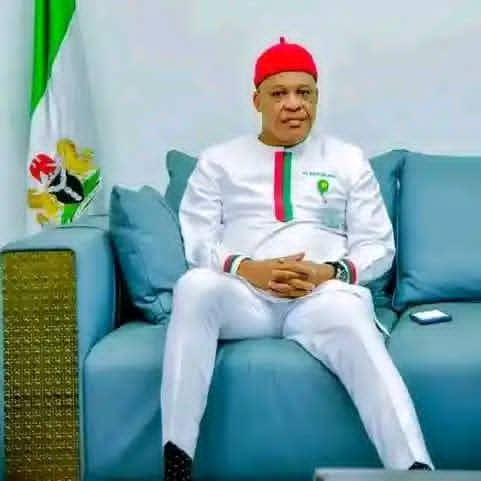
Going forward, the contest for Ikwuano/Umuahia North/South Federal Constituency is gradually narrowing to two frontline contenders, the incumbent, Hon Obi Aguocha versus Rt Hon Chinedum Orji of the APC. The duo squared off in 2023 and Aguocha carried the day, but the variables for the 2027 contest will definitely not be similar
As an incumbent, Aguocha has more going for him apparently. However, an assessment of the on-going campaign for the 2027 General Elections has shown an incumbent making intentional attempts to shift public attention away from questions regarding his scorecard from 2023 to date -his legislative performance, constituency projects and representation
Election campaigns are ultimately contests over trust. Candidates seek votes by telling constituents what they have done, what they intend to do and why they deserve another mandate – or a first mandate. For an incumbent, like Aguocha, the burden is even more direct. The relevant questions are not difficult: What bills has he sponsored? What motions has he moved? What constituency projects has he facilitated? What interventions have been secured? What issues affecting Ikwuano/Umuahia North and Umuahia South have been consistently raised at the federal level? These are measurable questions.
Membership of the House of Representatives carries constitutional responsibilities that go far beyond visibility at political events. A representative is expected to legislate, represent constituency interests, scrutinise government activity and participate in national policy-making.
Consequently, the central question for Ikwuano/Umuahia should be larger than the personalities involved. It should be: Who has the clearest understanding of the constituency’s problems, the strongest demonstrable record, the most credible legislative programme and the capacity to translate the mandate into measurable results? That is the standard against which every candidate should be measured
Ikwuano/Umuahia North and Umuahia South Federal Constituency is not just another federal constituency, but a strategic political zone. Past representatives were lawmakers of timber and capacity who, from all available facts left indelible legacies. From all available records, it appears Aguocha has no verifiable scorecard that could be used to justify his second term bid: There are no outstanding bills, no motions of significance, no mentionable interventions, no constituency projects.
It might seem uncharitable to suggest that Aguocha wasted three whole years in Abuja with nothing to show, but that is exactly the truth. From Ubakala to Ohuhu; From Olokoro to Ibeku; From Ikwuano to Amachara, Aguocha has no solid evidence to show that he stood the people of Ikwuano/Umuahia North/South in the Green Chamber
In the rural farming communities of Ikwuano LGA, he speaks of a phantom Federal Medical Centre, which exists only in his imagination; He speaks of bills to create Ikwuano North and South LGAs all mere proposals, no solidity, no evidence of anything tangible that could be realised before the legislative session terminates.
At Ubakala in Umuahia South LGA, he was thoroughly dressed down as his attempts to own projects executed by others were roundly resisted. Aguocha could not could not link the projects he claimed to any official appropriation, government record, completed project or documented legislative intervention. However officials of the Ubakala Clan Improvement Union were on hand to lecture him on who did what.
Aguocha’s embarrassing legacy as an absentee representative further emerged from a disclaimer from the prestigious elite social club, the Premier Club, Umuahia where he is a member. It is on their records that Aguocha not only distanced himself from the Club functions, but he equally owed membership levies and dues. But as he runs from pillar to post seeking a second term he does not deserve he recalled the club’s relevance in the scheme of affairs and quickly concocted a fake ‘endorsement’. But the rebuttal from the Club was fast and direct: ‘We Did Not Endorse You’
Perhaps in desperation, Aguocha has unfortunately reduced the campaigns to a motor park-like scenario of ‘ikonu’, backbiting and slanderous accusations. He has failed to showcase his performance based on facts, and measurable results from the responsibilities of his office
In contrast, Orji has since publicised his House of Assembly scorecard showcasing numerous targeted pieces of legislation designed to achieve specific socio-economic outcomes: Enacting laws that streamlined local tax structures to attract private investment into Abia State and championing regulatory frameworks that fostered youth inclusion and tech-driven entrepreneurship
Beyond the chamber floor, Orji leveraged his political capital to drive tangible socio-economic renewal. He recognized early on that a lawmaker’s secondary duty is to serve as an agent of development. His footprint across the constituency includes:
Youth Empowerment Re-engineered: Moving away from temporary political handouts, Orji focused on structural empowerment—facilitating sustainable employment, funding digital skill acquisition, and providing capital for small-to-medium enterprises (SMEs)
The people of Ikwuano/Umuahia need representation that addresses roads, employment, education, healthcare, agriculture, security, federal institutions, youth development and economic opportunity.
They also need a representative capable of navigating the complex relationship between constituency interests, the National Assembly and the Federal Government.
The constituency comprising Ikwuano, Umuahia North and Umuahia South all have developmental priorities, but they share one political interest: effective representation.
For Ikwuano, questions around agriculture, rural infrastructure, roads, education and economic opportunities remain important. For Umuahia North, as the location of the State capital, the expectations extend to stronger federal presence, infrastructure, employment and institutional development.
For Umuahia South, rural development, roads, youth opportunities, agriculture and access to federal programmes remain central concerns.
The National Assembly is an intensely competitive arena where 360 members vie for a finite pool of federal resources, budgetary allocations, and infrastructural projects. In this environment, a constituency’s success depends entirely on the status, capacity, and tactical maneuvers of its representative.
The core question facing the electorate is fundamentally structural: Do we entrust our collective future to a representative who is yet to master the complex labyrinthine corridors of the National Assembly, or do we deploy a tested legislative heavyweight who possesses the institutional network to deliver results from day one?
In sharp contrast, while Aguocha maintain a languid, indifferent approach in mastering and delivering on his legislative assignment, Orji has successfully bridged the gap between raw political influence and practical, documented record of state-level productivity. Indeed, in legislative governance, intentions exemplified by Aguocha are cheap, but enacted policies and visible infrastructure as shown by Orji are quantifiable